The Tay Bridge Opens to National Celebration. Eighteen Months Later, the Entire Central Section Collapses in a Storm and Takes a Train and 75 People with It
What happened
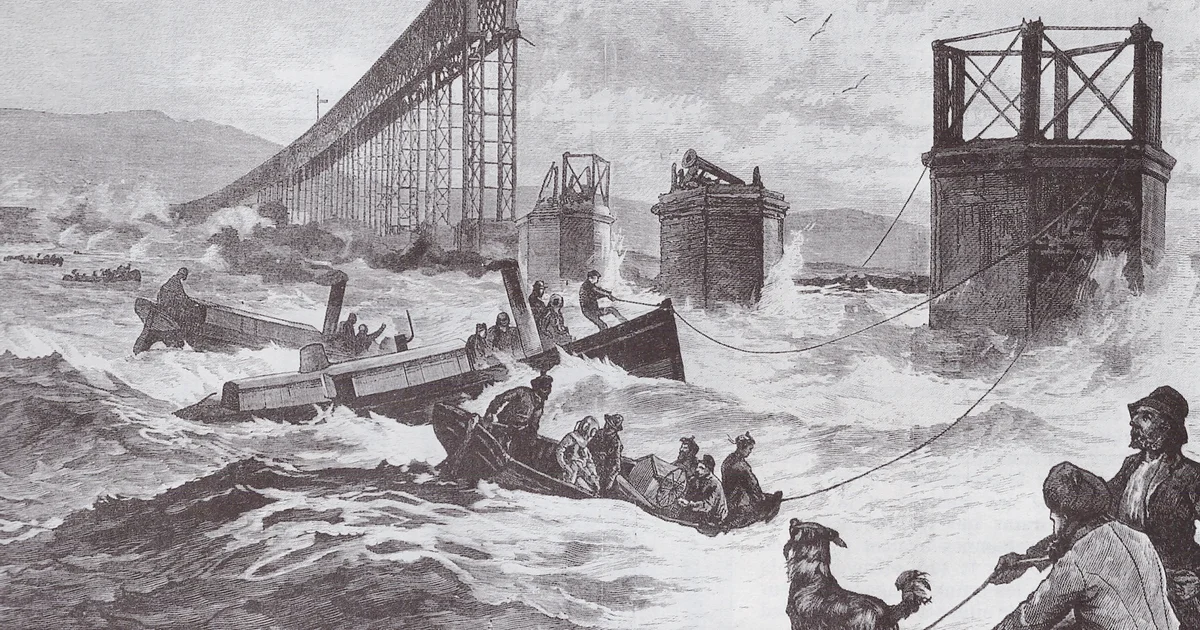
The Tay Bridge opened in May 1878 as the longest railway bridge in the world, spanning 3.5 kilometres across the Firth of Tay between Dundee and Wormit in Scotland. Queen Victoria crossed it by train in June 1879 and immediately knighted its designer, Thomas Bouch. On the evening of 28 December 1879, during a violent storm, the 13 central spans of the bridge — the 'high girders' section over the navigation channel — collapsed into the Firth of Tay. A passenger train from Edinburgh was crossing at the moment of failure. The locomotive, six carriages, and all 75 passengers and crew fell into the water. There were no survivors. The subsequent Board of Trade inquiry, led by Colonel William Yolland and barrister Henry Cadogan Rothery, found that the bridge was 'badly designed, badly built, and badly maintained.' Thomas Bouch's reputation was destroyed. He died eleven months later. The inquiry's findings triggered the first systematic standards for wind loading in British engineering — and the Forth Bridge, which Bouch had already been designing, was reassigned to different engineers who built it as one of the most deliberately over-engineered structures in the world.[1]
What went wrong
The Tay Bridge had structural failures at every level. The design assumed wind pressure of only 10 pounds per square foot — a figure that the inquiry found grossly insufficient for a structure of this exposure. Cast-iron columns in the high girder section were found, after recovery, to contain hidden voids and casting defects. These flaws had been concealed during construction using a standard filler known as 'Beaumont's egg' — a mixture of beeswax, iron filings, and lampblack applied to casting surfaces to disguise imperfections during inspection. The connecting lugs that held the columns to the bridge deck had cracked under operational loads; the maintenance record showed that bolts ('tie bars') had loosened repeatedly and were known to need tightening. The maintenance inspector tasked with overseeing the structure was near-sighted and, according to testimony, could not reliably identify defects. Bouch had consulted engineers and officials about wind loading requirements but had been given inadequate guidance — and had not sought independent verification. The bridge had been open for eighteen months when it failed. In those eighteen months, every passing locomotive was vibrating a structure whose connections were already deteriorating. The storm on 28 December did not destroy a sound bridge. It destroyed a bridge that was already failing.[1]
Lesson learned
The Tay Bridge inquiry produced what would become the first codified wind loading standards in British civil engineering. Before 1879, wind force calculations were left to individual engineers' judgement; after the disaster, minimum pressure specifications were introduced and eventually incorporated into formal building codes. The disaster also demonstrated how the concealment of construction defects — individually minor, tolerated as standard practice — can accumulate into catastrophic systemic vulnerability. Thomas Bouch simultaneously lost his professional reputation, his commission for the Forth Bridge, and his life. His successor on the Forth Bridge, Benjamin Baker, designed a structure so deliberately resistant to wind and failure modes that it used three times as much steel as Bouch would have specified. The Forth Bridge opened in 1890 and is still in service. Engineering standards often improve by one disaster at a time.
75 people died in 1879. Over 5.8 generations at a net reproduction rate of 1.2, each victim's line produces an estimated 3 living descendants today. Their combined lifetime economic output — 75 × 3 × $2.16M — represents value that was permanently removed from the world. This figure exceeds the primary damage estimate by more than 2× and is shown separately to avoid distorting cross-incident comparisons.
DVL = 75 × 1.25.8 × $2.16M · methodology §03E
Sources
- [1]
External links can go dark — pages move, paywalls appear, domains expire. Every source above includes a Wayback Machine snapshot link as a fallback. All citations are best-effort research; if a source contradicts our summary, the primary source takes precedence.