London Has Had a Fire Code Since 1189. By 1666, Nobody Has Enforced It for Decades. Then a Bakery Burns Down.
What happened
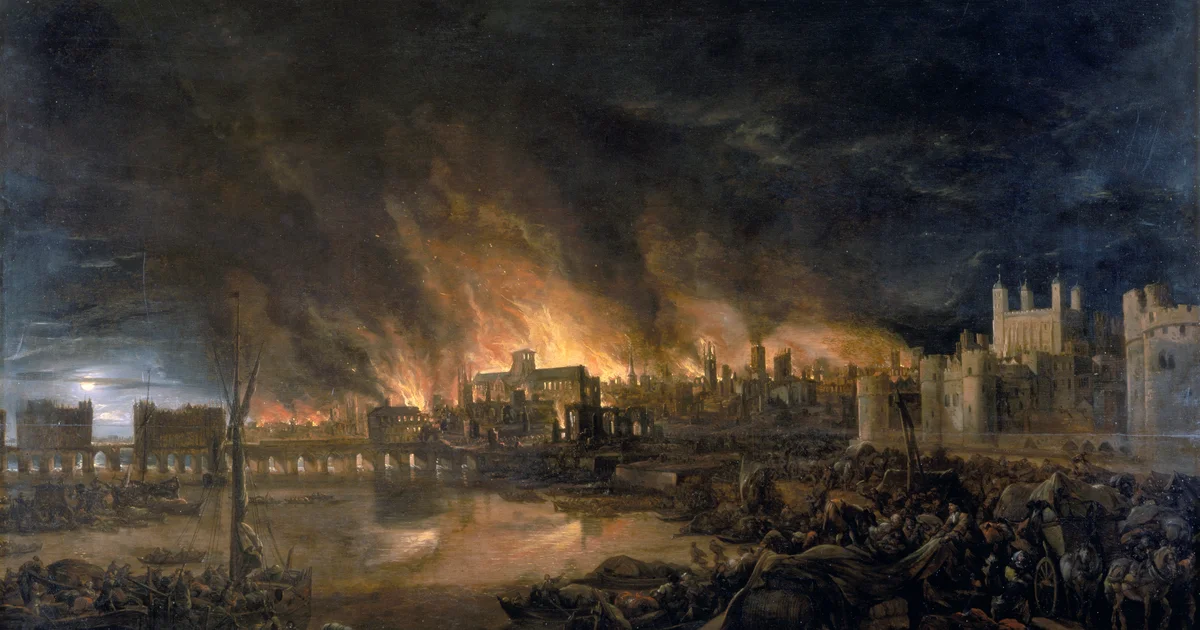
On 2 September 1666, a fire started in Thomas Farriner's bakery on Pudding Lane in the City of London and burned for four days. By the time it was out, 13,200 houses, 87 parish churches, St Paul's Cathedral, and most of the medieval City of London had been destroyed across 373 acres. Approximately 70,000 people — roughly one-sixth of London's entire population — were made homeless overnight. Only six deaths were officially recorded, as the fire moved slowly enough for evacuation. The City of London had fire regulations dating back to 1189: thatched roofs were prohibited, stone party walls were required, and firebreaks were mandated. They had been unenforced for so long that virtually none were followed. When Lord Mayor Sir Thomas Bloodworth was woken at three in the morning and shown the fire, he said 'A woman might piss it out' and went back to bed. By sunrise the fire was beyond control. King Charles II eventually ordered buildings demolished ahead of the fire to create firebreaks — the only measure that actually worked — but the order came too late and was too hesitantly enforced. The destruction of medieval London produced the first fire insurance company (1667), the first professional fire brigades, Christopher Wren's rebuilt city in brick and stone, and the Rebuilding Act of 1667 — the first serious building code in English history. The institutional framework of modern urban fire safety was written in the ashes of Pudding Lane.[1]
What went wrong
London's fire problem was not a secret. The city had burned seriously in 982, 1087, and 1135. The building regulations of 1189 had been put in place specifically because everyone knew a city of packed timber buildings was a fire waiting to happen. By 1666, those regulations had effectively ceased to exist. Landlords built in wood because it was cheap and fast. Overseers did not enforce because enforcement created enemies and generated no revenue. The city had grown dense and irregular, with upper stories projecting over narrow alleys that formed natural wind tunnels. The summer of 1666 had been unusually dry; the timber was tinder. The firefighting technology of the period — leather buckets, hand-operated water squirts that could project a weak stream perhaps fifteen feet, and long-handled fire hooks for pulling down thatch — was wholly inadequate for a fire of any real scale. There was no coordinated chain of command: parish constables, city watch, the Lord Mayor, and the King's court all had overlapping and unclear authority. The critical intervention — demolishing buildings ahead of the fire to create a firebreak — required the Lord Mayor's formal order to destroy private property, which Bloodworth refused to give on the first night because he feared lawsuits from the owners. By the time the King overrode him, the fire had progressed from a manageable incident to an unstoppable urban catastrophe.[1]
Lesson learned
The Great Fire of London is the origin point of modern building codes, fire insurance, and professional fire services — not because London invented these ideas after the fire, but because the economic cost of not having them finally exceeded the political cost of enforcing them. The regulations had existed for nearly five centuries before the fire. The problem was institutional, not technical: no enforcement mechanism, no liability, no financial incentive for compliance. Insurance changed this. The first fire insurance office, opened by Nicholas Barbon in 1667, created a direct financial stake in fire prevention. Insurance companies funded their own brigades to protect insured buildings — and refused to fight fires in buildings that weren't insured, which created a powerful market incentive to comply with safety standards. Every modern building code, fire brigade, and fire insurance policy descends from the four days in September 1666 when a wooden city discovered what a half-millennium of unenforced regulations actually looked like.
7 people died in 1666. Over 14.3 generations at a net reproduction rate of 1.2, each victim's line produces an estimated 14 living descendants today. Their combined lifetime economic output — 7 × 14 × $2.16M — represents value that was permanently removed from the world.
DVL = 7 × 1.214.3 × $2.16M · methodology §03E
Sources
- [1]
External links can go dark — pages move, paywalls appear, domains expire. Every source above includes a Wayback Machine snapshot link as a fallback. All citations are best-effort research; if a source contradicts our summary, the primary source takes precedence.