Tacoma Narrows Bridge Collapses Four Months After Opening — Engineers Had Ignored Resonance Warnings
What happened
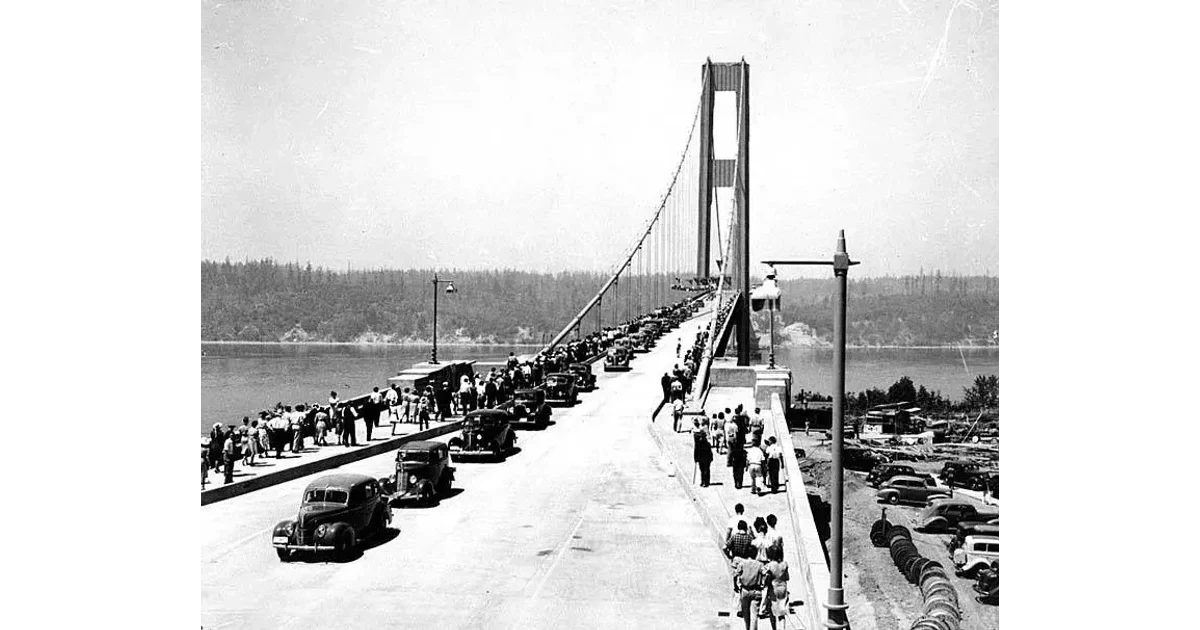
'Galloping Gertie', the Tacoma Narrows Bridge, opened on 1 July 1940 as the third-longest suspension bridge in the world. On 7 November 1940 — 129 days after opening — it entered a catastrophic resonant oscillation in a 68 km/h wind, developing a twisting motion exceeding 8 metres. The roadway tore apart and collapsed into Puget Sound. No humans were killed, though a dog named Tubby, whose owner could not carry him from the swaying deck, perished. The collapse was captured on film and became one of the most studied engineering failure videos in history.[1]
What went wrong
Designer Leon Moisseiff applied a fashionable 'deflection theory' that allowed much shallower deck girders than previous bridges. The design prioritised aesthetics over aerodynamic stability: where the Golden Gate used open trusses 7.6 metres deep that let wind pass through, Tacoma Narrows used solid plate girders 2.4 metres deep that acted as a sail. Engineers and the state authority had received informal warnings about the bridge's oscillations before opening. Aerodynamic forcing at a particular wind speed matched the bridge's natural torsional frequency — a well-understood mechanical engineering phenomenon that had not been applied to bridge design.[1]
Lesson learned
Tacoma Narrows fundamentally changed civil engineering: every suspension bridge since 1940 includes aerodynamic wind tunnel testing and open-truss deck configurations. The disaster showed that structural aesthetics and structural engineering are not always compatible, and that known physical principles must be applied cross-discipline. It introduced aeroelastic flutter to bridge engineering — now central to all long-span bridge design. Cost and schedule pressure that pushed a cheaper, sleeker design killed a bridge in 129 days.
Sources
- [1]
External links can go dark — pages move, paywalls appear, domains expire. Every source above includes a Wayback Machine snapshot link as a fallback. All citations are best-effort research; if a source contradicts our summary, the primary source takes precedence.