Hindenburg Ignites Amid Hydrogen Politics, Killing 36 and Ending the Airship Era
What happened
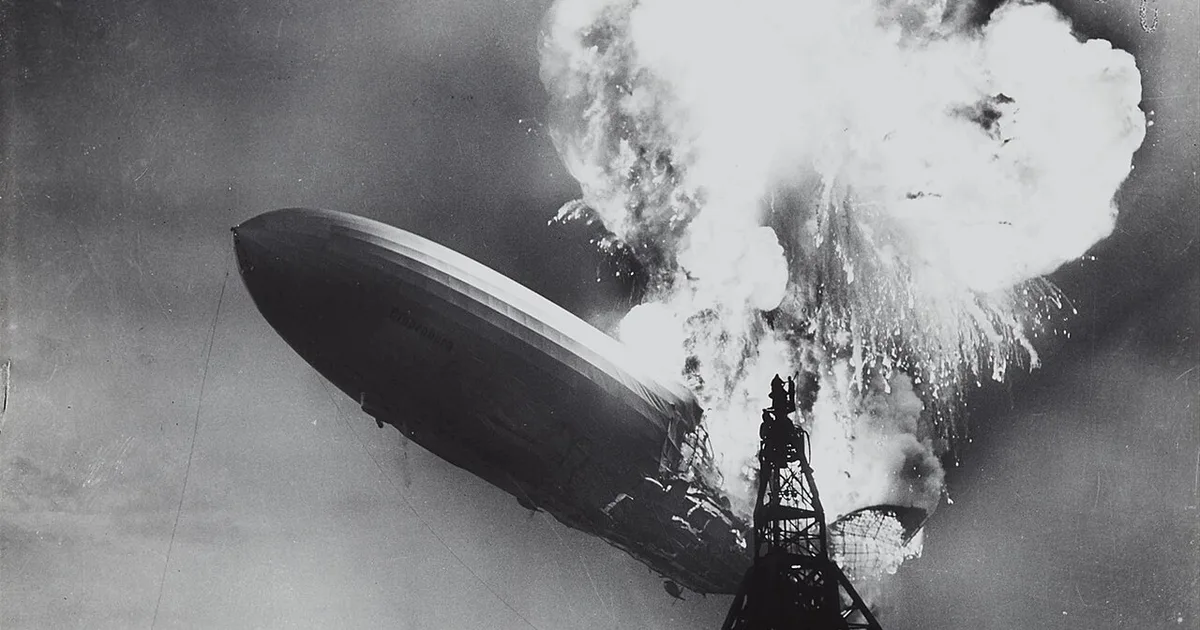
The German airship LZ 129 Hindenburg burst into flames while docking at Lakehurst, New Jersey on 6 May 1937, killing 36 of the 97 people on board and destroying the $3M (1937) vessel in 34 seconds. The disaster ended the commercial airship era almost overnight. The Hindenburg should have used non-flammable helium, but the United States had banned helium exports — largely due to its potential military use — leaving Germany with no choice but highly flammable hydrogen.[1]
What went wrong
The US Helium Control Act of 1927 banned export of helium to foreign nations; the US had a near-monopoly on global helium production. German engineers designed the Hindenburg for helium but were forced to operate on hydrogen. The exact ignition cause remains disputed — static discharge from wet mooring lines, a leaking gas cell, or sabotage — but the outcome was determined long before landing: hydrogen made any ignition catastrophic. The ship's outer cover was also coated with a highly flammable iron-oxide and cellulose acetate dope, which accelerated the fire.[1]
Lesson learned
Political and export-control decisions made at national level can force safety-critical engineering compromises that manifest as disasters years later. The risk was known; the German team accepted it because the alternative was not flying at all. When acceptable risk is determined by geopolitics rather than engineering, the engineering team inherits a problem they cannot solve.
36 people died in 1937. Over 3.5 generations at a net reproduction rate of 1.2, each victim's line produces an estimated 2 living descendants today. Their combined lifetime economic output — 36 × 2 × $2.16M — represents value that was permanently removed from the world.
DVL = 36 × 1.23.5 × $2.16M · methodology §03E
Sources
- [1]
External links can go dark — pages move, paywalls appear, domains expire. Every source above includes a Wayback Machine snapshot link as a fallback. All citations are best-effort research; if a source contradicts our summary, the primary source takes precedence.