The Worst Maritime Disaster in U.S. History That Nobody Remembers
What happened
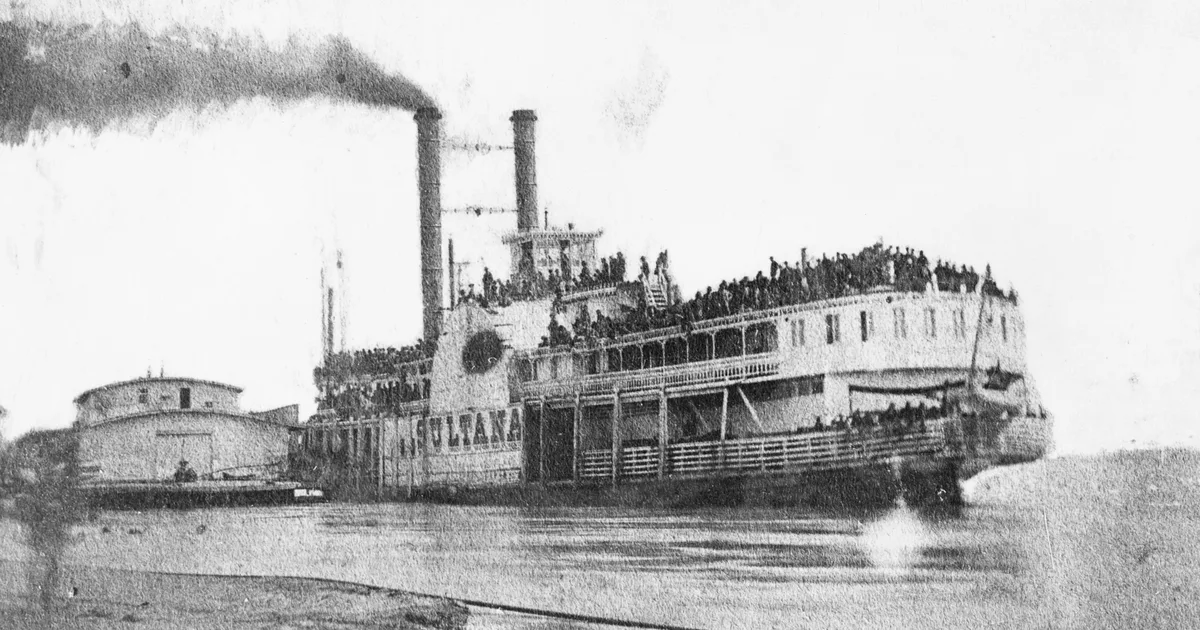
On 27 April 1865, the steamboat SS Sultana exploded on the Mississippi River, killing approximately 1,800 people — mostly Union soldiers returning home after surviving Confederate prison camps. The disaster was overshadowed by Lincoln's assassination two weeks earlier. The cause was a boiler that had been negligently patched instead of properly repaired, combined with catastrophic overloading driven by bribery.[1]
What went wrong
The SS Sultana was a Mississippi River side-wheel steamboat with an official passenger capacity of 376. On 24–25 April 1865, the ship took on approximately 2,300–2,500 passengers at Vicksburg, Mississippi — nearly seven times its legal capacity. The majority were Union soldiers who had survived Andersonville, Cahaba, and other Confederate prison camps and were being transported north for mustering out. The overloading was the result of a bribery scheme. Union Army officers responsible for distributing freed prisoners across available transport were paid per head by steamboat captains competing for the lucrative government contract. Captain J. Cass Mason and army officer Captain Reuben Hatch — later investigated but never convicted — arranged for the Sultana to receive the bulk of the prisoner transport regardless of its condition or capacity. Three of the four boilers had developed cracks during the upriver journey. At Vicksburg, a makeshift patch was applied by a local boilermaker using a single-thickness plate instead of the required two-layer repair. The ship's chief engineer objected and requested a full repair. He was overruled — delaying for a proper fix would have allowed a competing vessel to take the prisoners. At approximately 2 a.m. on 27 April 1865, seven miles north of Memphis, all three patched boilers exploded simultaneously. The explosion destroyed the middle of the ship, igniting the wooden superstructure and dumping thousands of men — most unable to swim, weakened by months of captivity — into the Mississippi in darkness. Approximately 1,800 people died, making the Sultana disaster the deadliest maritime accident in American history, surpassing the Titanic by 300 lives. The disaster received minimal press coverage. John Wilkes Booth had been shot and killed two days earlier; the country's attention was entirely on the end of the Civil War and the assassination aftermath. No one was ever convicted of any offence.[1]
Lesson learned
A single-thickness patch on a cracked high-pressure boiler is not a repair — it is a delay. The engineer who objected was right. The officer who overruled him to avoid losing a government contract killed 1,800 people. Bribery that corrupts safety decisions is not a business risk: it is a murder weapon.
Sources
- [1]
External links can go dark — pages move, paywalls appear, domains expire. Every source above includes a Wayback Machine snapshot link as a fallback. All citations are best-effort research; if a source contradicts our summary, the primary source takes precedence.