Henry VIII Orders More Guns: The Mary Rose Is Overloaded, Heels Over, and Sinks in Minutes While the King Watches
What happened
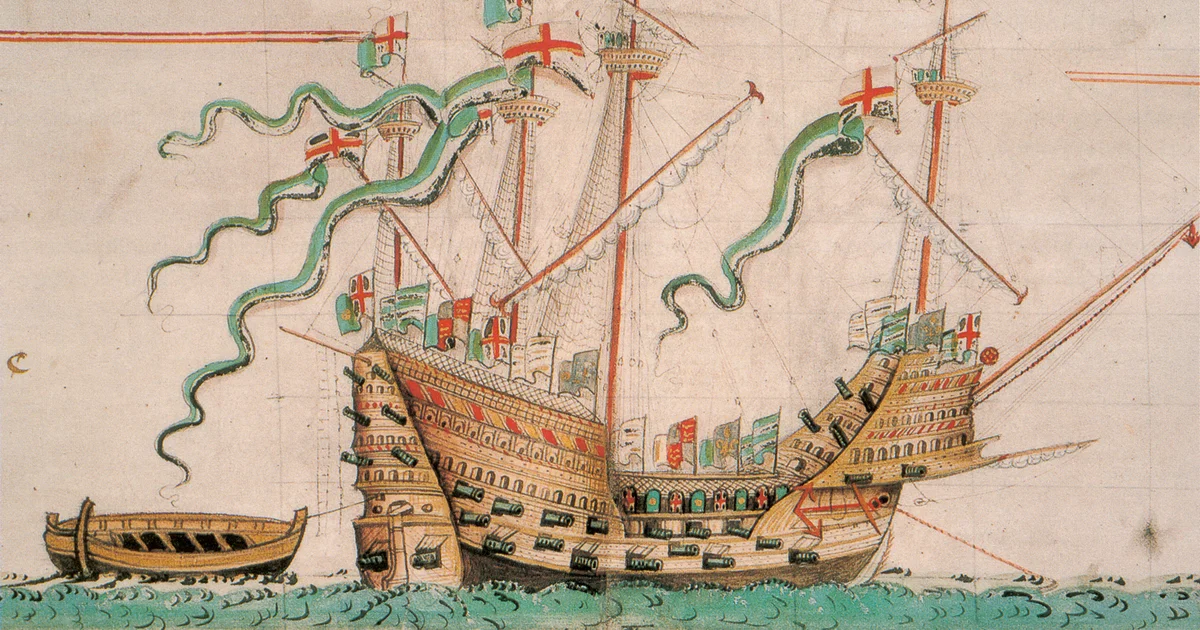
On 19 July 1545, King Henry VIII stood at Southsea Castle and watched his flagship, the Mary Rose, sail out to repel a French invasion fleet of 225 ships. Within minutes of engaging the enemy, the ship heeled sharply, water flooded through its open lower-deck gun ports, and it sank in less than a minute. Of the estimated 500 men aboard, fewer than 35 survived. The ship had been rebuilt nine years earlier to carry significantly more guns than its original design allowed — moving the lower gun ports to within 41 centimetres of the waterline when fully loaded. The anti-boarding nets installed to protect against French boarders trapped English sailors trying to escape. Henry reportedly heard the screams of the drowning men from shore.[1]
What went wrong
The Mary Rose was originally built in 1510–1511 as a state-of-the-art warship carrying 78 guns. In 1536, Henry VIII ordered a major refit to modernise the vessel and increase its firepower. The rebuilt ship carried 91 guns — including heavier bronze cannons on the lower decks — and was packed with an unusually large complement of soldiers. The additional weight pushed the hull deeper into the water, leaving the lower-deck gun ports dangerously close to the waterline: at full load, as little as 41 cm of freeboard separated the open ports from the sea. On the day of battle, the lower gun ports were open for action. When the ship turned to engage the French, a gust of wind caused her to heel. Water poured through the open ports. The crew had no time to close them. The ship went down in under a minute. A second compounding failure: heavy rope anti-boarding nets had been rigged across the upper decks to prevent the French from climbing aboard. When the ship began to sink, the same nets that were meant to save the ship trapped the men trying to swim free.[1]
Lesson learned
The Mary Rose is a 16th-century case study in what modern engineers call 'requirements creep driven by authority': a commander demands capabilities beyond what the original design can safely deliver, and engineers comply rather than refuse. The 1536 refit added guns, weight, and soldiers without adequately reconsidering the ship's stability margins. The lower gun port height — a fixed architectural constraint — became a fatal vulnerability the moment the waterline rose. The anti-boarding nets, a sensible defensive feature in isolation, became lethal in combination with a sinking ship. Centuries later, the same pattern — individually reasonable decisions that combine into catastrophe — appears in the Vasa (1628), the Challenger (1986), and the Boeing 737 MAX (2019).
500 people died in 1545. Over 19.2 generations at a net reproduction rate of 1.2, each victim's line produces an estimated 33 living descendants today. Their combined lifetime economic output — 500 × 33 × $2.16M — represents value that was permanently removed from the world. This figure exceeds the primary damage estimate by more than 2× and is shown separately to avoid distorting cross-incident comparisons.
DVL = 500 × 1.219.2 × $2.16M · methodology §03E
Sources
- [1]
External links can go dark — pages move, paywalls appear, domains expire. Every source above includes a Wayback Machine snapshot link as a fallback. All citations are best-effort research; if a source contradicts our summary, the primary source takes precedence.