Mars Pathfinder: Priority Inversion Bug Keeps Crashing the Rover Computer — Diagnosed from 180 Million Kilometres Away, Fixed by Remote Patch
What happened
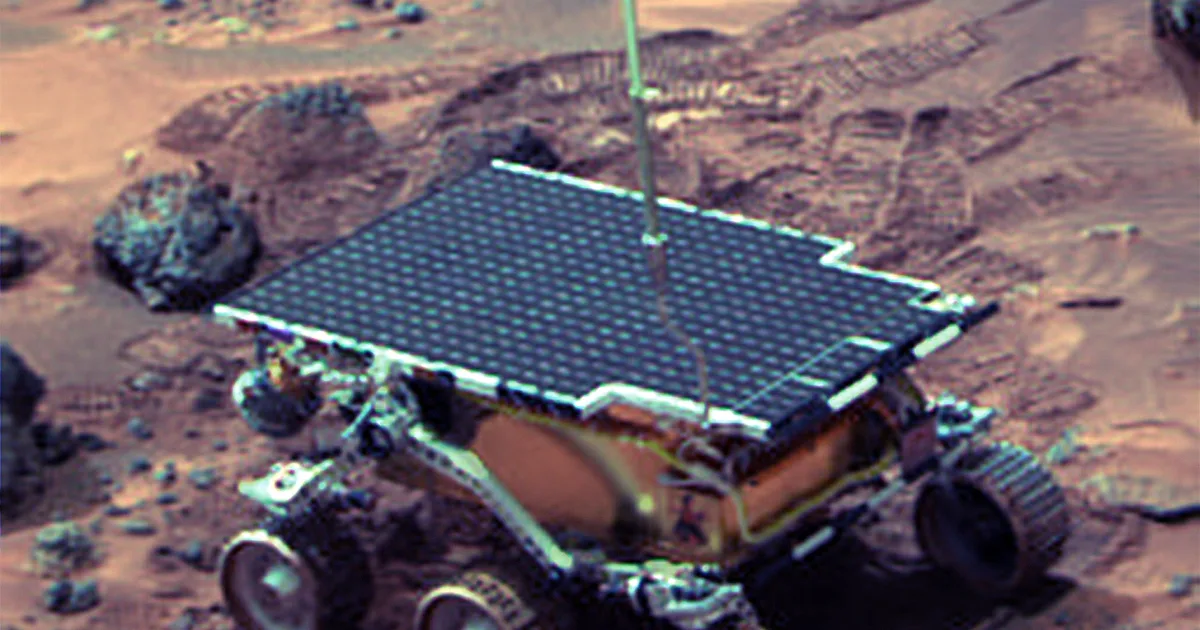
In July 1997, NASA's Mars Pathfinder landed successfully and deployed the Sojourner rover — the first wheeled vehicle on another planet. Within days, the spacecraft's computer began resetting itself unpredictably, sometimes several times a day. Mission controllers could see the resets in telemetry but not the cause. The fault turned out to be a textbook priority inversion in the VxWorks real-time operating system: a low-priority meteorological task was holding a shared mutex when a high-priority communications task needed it, while a medium-priority task kept preempting the first, starving the watchdog timer until it triggered a full system reset. The bug had appeared in pre-launch testing and been judged too unlikely to address. The JPL team reproduced it in simulation on Earth, identified the fix — enabling priority inheritance on the mutex — and uplinked the parameter change to a spacecraft on Mars. The resets stopped. The mission completed successfully.[1]
What went wrong
The Mars Pathfinder flight computer was an IBM RAD6000 running Wind River's VxWorks real-time operating system. The spacecraft used a shared data bus protected by a mutex — a standard synchronisation primitive that prevents two threads from modifying shared state simultaneously. VxWorks mutexes support an option called priority inheritance, which temporarily elevates a low-priority task's priority when it holds a mutex needed by a higher-priority task. This prevents the classic priority inversion scenario. On Pathfinder, priority inheritance had been disabled on the information bus mutex, apparently to reduce scheduling overhead. The scenario that caused the resets worked as follows. The low-priority ASI/MET meteorological task would acquire the information bus mutex to publish sensor data. Before it could release the mutex, a medium-priority task (image processing or rover telemetry) would preempt it and run. The high-priority communications task, meanwhile, was blocked waiting for the mutex. After a set interval without the communications task completing, VxWorks's watchdog timer concluded the system had hung and issued a full reset — taking all in-progress science data with it. The crucial detail is that this exact failure mode had been observed during ground testing before launch. The test team logged it, noted that it required a very specific timing alignment to reproduce, and concluded it was too improbable to justify a fix. It was not too improbable. On Mars, with the meteorological task running continuously at its scheduled interval, the necessary timing alignment occurred daily. The bug was not a surprise; it was a known risk that had been explicitly filed and set aside.[1]
Lesson learned
The Pathfinder priority inversion is one of the most widely cited examples in real-time systems engineering, cited in every serious OS course since 1997, because it demonstrates three things simultaneously. First, that concurrency bugs which are rare in testing can become near-certain in production when the load profile changes. The timing alignment required to trigger the inversion was infrequent in the lab; the meteorological task's real-world duty cycle made it frequent on Mars. Second, that 'too unlikely to fix' is not the same as 'will not happen'. The risk was known, documented, and deferred. It materialised within days of deployment. The cost of enabling priority inheritance — a single boolean flag in the VxWorks configuration — was negligible. The cost of the daily resets, in lost science data and mission-operations time, was not. Third, and most remarkably: the fix worked. The JPL team reproduced the bug in a ground simulation from telemetry alone, identified the patch, tested it on an identical Earth-based system, and uplinked it to Mars. The resets stopped. This was one of the first successful remote software patches of a spacecraft in flight, and it established a precedent for treating deployed spacecraft software as live, patchable systems rather than frozen read-only binaries. The failure led directly to better practices for both.
The Mars Pathfinder mission cost approximately $265 million (1997). The priority inversion bug did not destroy the mission — it was diagnosed and patched — but every system reset wiped in-progress science data and consumed scarce engineering hours. No mission hardware was lost and the mission completed successfully, so no direct financial damage is calculable. The value at risk was the full $265 million mission cost.
Sources
- [1]
External links can go dark — pages move, paywalls appear, domains expire. Every source above includes a Wayback Machine snapshot link as a fallback. All citations are best-effort research; if a source contradicts our summary, the primary source takes precedence.