Apollo 1 Launchpad Fire Kills Three Astronauts: Pure Oxygen Cabin and 560 km/h Wiring Were Known Risks
What happened
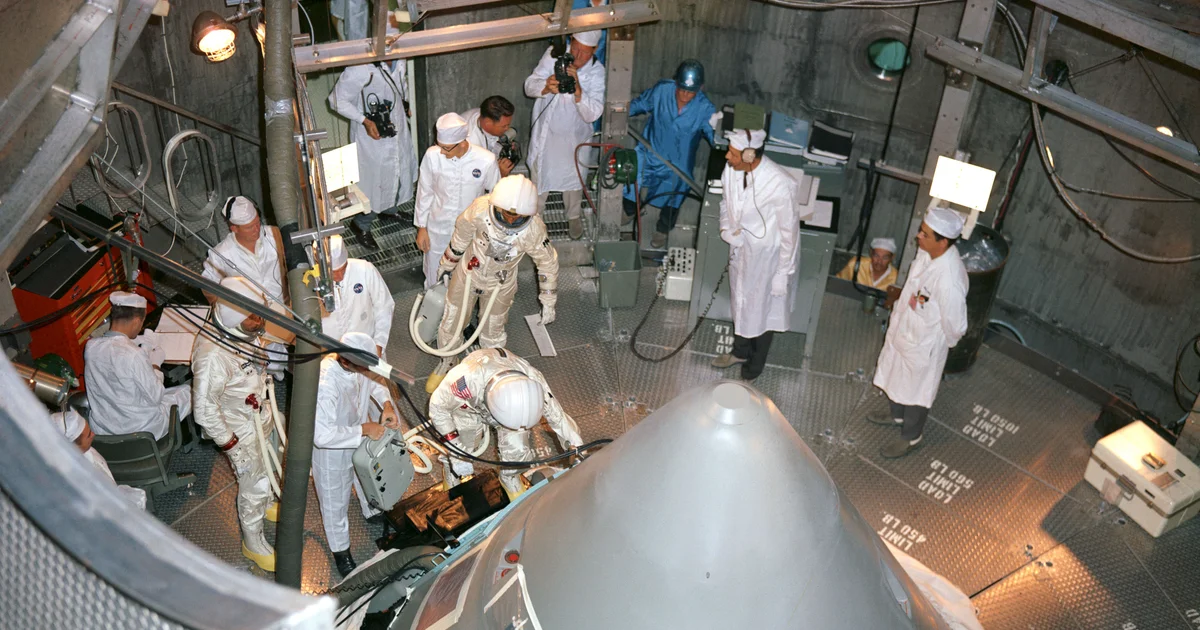
On 27 January 1967, astronauts Gus Grissom, Ed White, and Roger Chaffee were killed during a routine pre-launch rehearsal test on Launch Pad 34 at Cape Kennedy. A fire ignited inside the Command Module in a 100% pure oxygen atmosphere pressurised above ambient — conditions that made any spark catastrophic. The crew were unable to open the inward-swinging hatch under pressure. All three died of asphyxiation within 17 seconds of the first alarm. The Apollo programme was grounded for 21 months.[1]
What went wrong
NASA and prime contractor North American Aviation had received over 600 open engineering discrepancy reports on the Command Module, including repeated warnings about flammable materials and faulty wiring. The cabin used 100% pure oxygen at 16.7 psi — a mixture that turns almost any material into fuel. Wiring ran at speeds up to 560 km/h through cramped bundles, generating heat. The inward-opening hatch required 90 seconds to open in ideal conditions and could not be opened at all with internal overpressure. The test was classified 'non-hazardous' because no propellant was loaded — a classification that ignored the oxygen atmosphere itself as a primary hazard. Grissom had famously hung a lemon on the simulator months earlier to protest the capsule's poor quality.[1]
Lesson learned
Apollo 1 forced a complete redesign: the hatch became an outward-opening quick-release taking three seconds; cabin atmosphere switched to 60/40 nitrogen-oxygen mix at sea level, transitioning to pure oxygen only in space at low pressure; flammable materials were replaced; and NASA created a formal safety review process that did not exist before. The deaths are credited with giving NASA the institutional authority to ground programmes over safety concerns — a precedent that was tragically forgotten with Challenger and Columbia.
3 people died in 1967. Over 2.3 generations at a net reproduction rate of 1.2, each victim's line produces an estimated 2 living descendants today. Their combined lifetime economic output — 3 × 2 × $2.16M — represents value that was permanently removed from the world.
DVL = 3 × 1.22.3 × $2.16M · methodology §03E
Sources
- [1]
External links can go dark — pages move, paywalls appear, domains expire. Every source above includes a Wayback Machine snapshot link as a fallback. All citations are best-effort research; if a source contradicts our summary, the primary source takes precedence.