Webvan Burns $1.2 Billion on Same-Day Grocery Delivery, Then Declares Bankruptcy After 18 Months of Operation
What happened
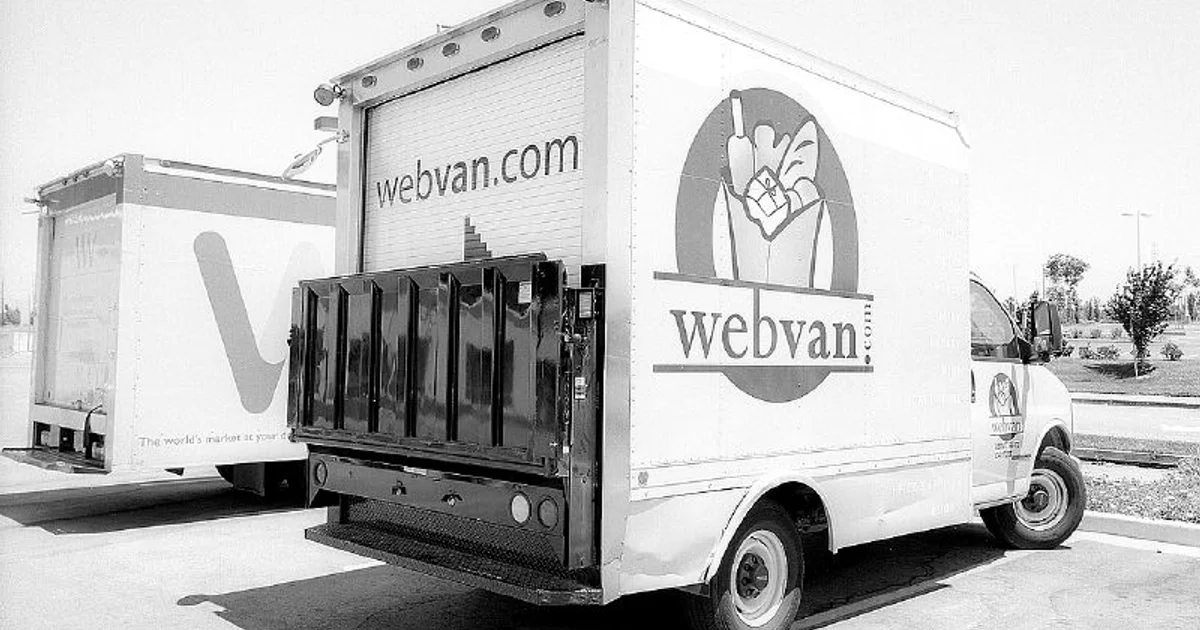
Webvan launched in 1999 with a bold promise: same-day grocery delivery within a 30-minute window, using purpose-built $35M automated warehouses, a fleet of branded vans, and an IT infrastructure that cost more than most supermarket chains. Backed by $375M from Sequoia Capital, Goldman Sachs, and others, the company IPO'd in November 1999 and raised another $375M — reaching a market cap of $1.2 billion on its first trading day. By July 2001, just 18 months after launch, Webvan had burned through $1.2 billion, filed for Chapter 11, and laid off 2,000 employees. The warehouses — built to handle ten times the orders Webvan ever received — were sold at pennies on the dollar.[1]
What went wrong
Webvan's fundamental error was treating a logistics efficiency problem as a technology problem, and scaling at venture speed before proving unit economics at any single market. The company's first market, the San Francisco Bay Area, was never profitable; it expanded to nine new cities anyway, each requiring a $35M warehouse and hundreds of employees hired months before the first customer order. The automated warehouse software was perpetually behind schedule. Grocery margins are razor-thin — typically 2-4% — which meant the home delivery premium had to be enormous just to approach breakeven. Customers loved the service but wouldn't pay enough for it to cover costs. The company spent $26.75 in delivery costs for every order. The model required each warehouse to handle 8,000 orders per day to break even; Webvan's best market managed 2,000.[1]
Lesson learned
Webvan became the canonical case study for 'premature scaling' and the dot-com assumption that growth could substitute for profit indefinitely. The company raised enough money to build an infrastructure for a profitable business — but at ten times the scale it actually needed — before validating that the business model worked at all. The grocery delivery idea was correct: Amazon Fresh, Instacart, and DoorDash all eventually proved the market. Webvan's mistake was not the vision but the execution: build first, learn never. Twenty years later, Instacart reached the same market without owning a single warehouse.
Sources
- [1]
External links can go dark — pages move, paywalls appear, domains expire. Every source above includes a Wayback Machine snapshot link as a fallback. All citations are best-effort research; if a source contradicts our summary, the primary source takes precedence.